Keeping track of conference deadlines is an essential part of academic life, and the good news is that several free tools exist to help. The bad news is that they all have different strengths and weaknesses, and choosing the wrong one can leave you with gaps in your coverage.
This guide compares the most popular conference deadline trackers available to researchers in 2026. We have tried to be as fair as possible in our assessment - every tool on this list is genuinely useful, and the best choice depends on your specific needs.
1. aideadlin.es
aideadlin.es is one of the most well-known deadline trackers in the AI and machine learning community. It has been around for several years and has earned a loyal following among NeurIPS, ICML, and ICLR submitters.
Pros
- Clean, simple interface with countdown timers
- Strong coverage of AI/ML conferences
- Open-source and community-maintained
- Calendar subscription feed available
- Well-established with a large user base
Cons
- Primarily focused on AI/ML - limited coverage of HCI, systems, security, software engineering, and other CS fields
- No organization or ranking filters (cannot filter by ACM, IEEE, or conference tier)
- No project management or kanban board integration
- Web-only - no browser extension
Best for: AI/ML researchers who only submit to AI-focused conferences and want a simple, no-frills countdown page.
2. CCF Deadline (ccfddl.github.io)
CCF Deadline is a community-driven tracker that uses the China Computer Federation rankings to organize conferences. It covers a broader range of CS fields than aideadlin.es.
Pros
- Broader CS coverage including systems, networking, databases, and theory
- CCF ranking integration (A, B, C tiers)
- Field-based filtering
- Open-source and regularly updated
Cons
- Uses CCF rankings, which differ from ICORE and may not be the standard in all regions
- Interface is more utilitarian - less polished design
- No calendar export functionality
- No browser extension or Overleaf integration
- No project management features
Best for: Researchers in Chinese academia or those who specifically follow CCF rankings across multiple CS subfields.
3. WikiCFP
WikiCFP (wikicfp.com) is one of the oldest conference tracking resources. It aggregates calls for papers across all academic disciplines, not just computer science.
Pros
- Massive coverage - thousands of conferences and workshops across all fields
- Includes workshops and symposia, not just top-tier conferences
- Community-contributed entries
- Covers fields beyond CS (engineering, social sciences, medicine)
Cons
- Outdated interface that has not been significantly updated in years
- No live countdown timers
- No ranking or quality filters - hard to distinguish top venues from predatory conferences
- Data quality can be inconsistent since entries are community-submitted
- No calendar export, no browser integration
Best for: Researchers looking for niche workshops or conferences outside mainstream CS, where other trackers have no coverage.
4. Vdeadline.org
Vdeadline is a newer deadline tracker focused on computer vision and related fields. It offers a clean interface similar to aideadlin.es but with a tighter scope.
Pros
- Focused, curated list for computer vision researchers
- Clean modern interface
- Includes both deadlines and notification dates
Cons
- Very narrow coverage - only computer vision and closely related venues
- Smaller conference database
- No browser extension or calendar export
- No project management features
Best for: Computer vision researchers who only need deadlines for CVPR, ICCV, ECCV, and related venues.
5. PaperPilot
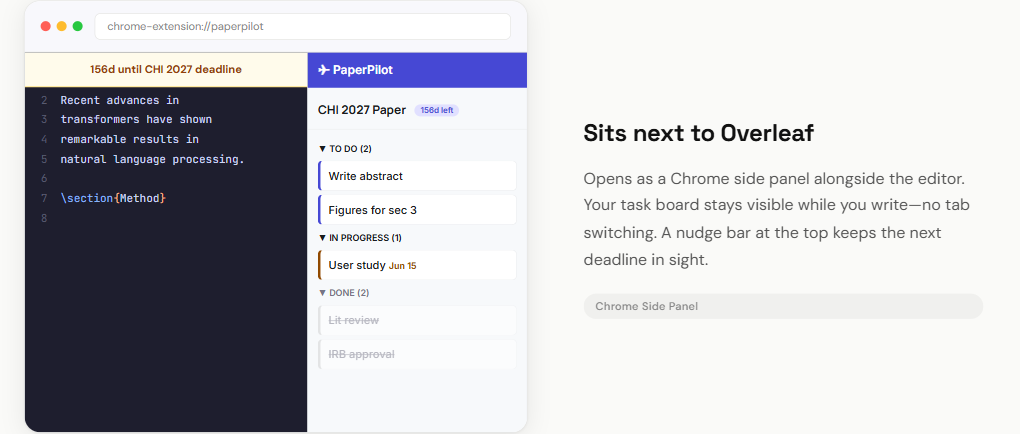
PaperPilot is a free browser extension and web-based deadline tracker built specifically for researchers who write in Overleaf. It combines deadline tracking with project management tools in a single package.
Pros
- Largest conference database: Over 1,200 conferences covering all CS fields
- ICORE 2026 rankings: Filter by A*, A, B, or C tier using internationally recognized rankings
- Organization filters: Filter by ACM, IEEE, USENIX, AAAI, and specific SIGs (SIGCHI, SIGPLAN, SIGMOD, etc.)
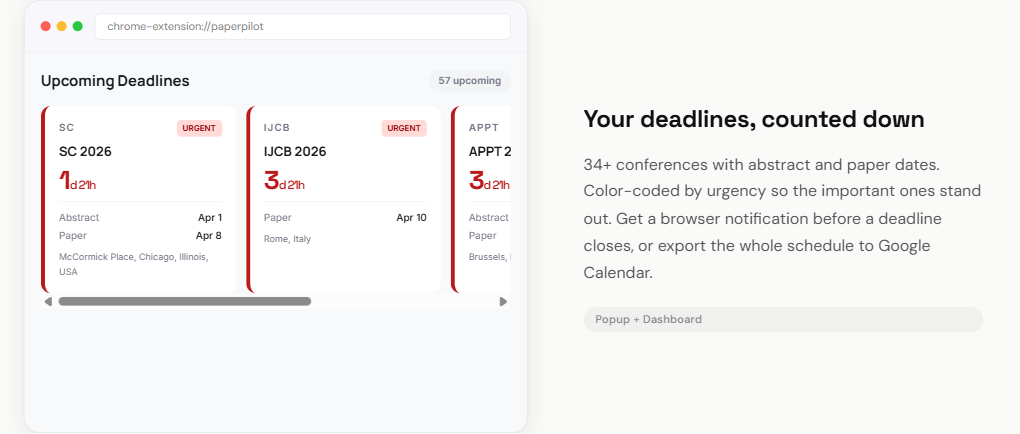
- Live ticking countdowns that update in real time
- Calendar export: One-click Google Calendar integration and .ics download
- Browser extension: See deadlines inside Overleaf without switching tabs
- Kanban boards: Manage your paper pipeline with projects linked to conference deadlines
- Citation helper: Search and insert BibTeX citations directly in Overleaf
- Timezone conversion: Automatic local time display for all deadlines
- Completely free - no paid tiers, no trial limitations
Cons
- Chrome-only - no Firefox or Safari extension (the web tracker works in any browser)
- Extension features are focused on Overleaf - less useful if you write in Word or Google Docs
- Newer tool with a smaller community compared to aideadlin.es
Best for: Researchers who use Overleaf and want deadline tracking, project management, and citation tools in one place. Also ideal for anyone who needs to track conferences across multiple CS fields with ranking and organization filters.
How do these deadline trackers compare?
Here is a quick summary of how these tools compare on the features that matter most:
- Conference coverage: WikiCFP (broadest but unfiltered) > PaperPilot (1,200+) > CCF Deadline > aideadlin.es > Vdeadline
- Live countdowns: PaperPilot, aideadlin.es, Vdeadline
- Ranking filters: PaperPilot (ICORE), CCF Deadline (CCF)
- Calendar export: PaperPilot (Google Calendar + .ics), aideadlin.es (feed)
- Browser extension: PaperPilot only
- Project management: PaperPilot only
- Citation helper: PaperPilot only
- Cost: All free
Which deadline tracker should I use?
If you only work in AI/ML and want the simplest possible experience, aideadlin.es does the job well. If you need CCF-specific rankings, CCF Deadline is purpose-built for that. If you are looking for obscure workshops or non-CS conferences, WikiCFP has the broadest net.
But if you want the most complete package - a large conference database with international rankings, real-time countdowns, calendar integration, and tools to actually manage your paper submissions - PaperPilot covers more ground than any single alternative. And since everything is free, there is no downside to trying multiple tools and seeing which one fits your workflow best.
You can start with the PaperPilot web deadline tracker right now - no installation required.